


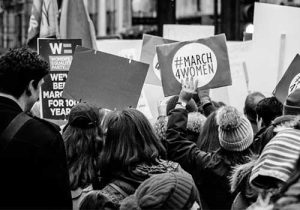
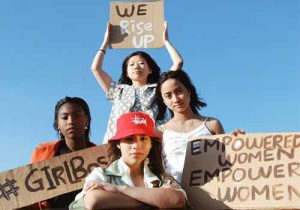
Many writers and thinkers, both in and outside academia suggest that over the past decade we’ve entered a fourth wave of feminism. One of the characteristics of this fourth wave is how it utilises and is shaped by social media. In the past ten years many women’s rights movements around the world have either started on social media or used social media strategies to voice their demands for change.
Zeynep Tufekci reflects in her analysis of the Alabama bus strike during the US civil rights movement on the huge effort required to get the word out across the city in a short time frame, including the challenge of printing and distributing vast numbers of flyers in an era before modern photocopiers. Today when using social media, calls for similar collective action can spread around the world with ease and speed.
Zeynep argues throughout her book Twitter and Teargas that because coordination of large scale action is so much easier since the emergence of social media the strong networks needed for the relentless long term struggle often required to deliver lasting change might never be established.
New communication technologies lead to new communication strategies
Where movements in the past largely relied on traditional, or old, media to draw attention to their causes today social media can generate the newsworthiness of a campaign on its own. As I’ve reflected on before though, the same people (and the same events) that tend to gain attention in old media are often the ones that will trend on social media too.
The way social media platforms function, the content (and length thereof) they allow, the algorithms they use, and the types of content that’s popular on a specific platform at a particular time, impacts the strategies that feminist activists use. L. Ayu Saraswati uses the term ‘neo-liberal selfie’ to describe the way many feminist activists shape their social media persona using a range of tactics to make their activism appealing and far reaching.
While social media savvy people are utilising platforms to draw attention to oppression, abuse, and inequality around the world it is just as difficult for movements, especially those led by generally marginalised voices, or those without the skills or resources to utilise social media platforms as well, to both gain and keep attention for their issues.
A new audience for the same old grievances
Pallavi Guha shares an anecdote in her book Hear #MeToo in India about how as a university student in India, she and other women students would let new students know what male teachers had a history of sexual harassment through a whisper campaign. In 2017 Raya Sarkar launched a campaign (#LoSHA – List of Sexual Harassers in Academia) to do the same. On Twitter, however, there was an audience beyond the young women trying to protect their peers and some academics faced repercussions for their actions.
I think this is one of the big changes we’re seeing with social media. How expressions of everyday grievances that many women have suffered in silence for so long can now be communicated to an audience with ease (at least practically, I am sure women speaking out about their traumas on social media are finding it everything but easy).

At its best these outpourings shine a light on the systemic nature of the discrimination, abuse, and harassment that many women face and lead to policy changes. Like in the case of the #UpskirtingLaw in the UK. At its worst though it puts the women speaking out about their own trauma or systemic oppression at risk of further harassment and abuse from trolls or authoritarian regimes while perpetrators are able to continue their lives largely unaffected.
Are we in a more intersectional feminist wave?
Along with the digitalisation of feminist activism, a key feature assigned to fourth wave feminism is an increased understanding of and focus on intersectionality and inclusivity.
My next blog will analyse how these two factors – digitalisation and increased intersectionality and inclusion of marginalised women are potentially contradictory by looking at women’s rights movements in India. A country with millions of active social media users, and millions of people without access to the technology, literacy, and digital skills needed to make one’s voice heard on these platforms.
In the meantime, I’d love to hear how you see the structures of social media platform shaping today’s feminist activism?

